
SERVICE
Utility Trenching & Backfill
Precision utility installation for mountain terrain — water, sewer, gas, power, and data to every structure on your site.
THE PITCH
Every Utility Line, Buried Right the First Time
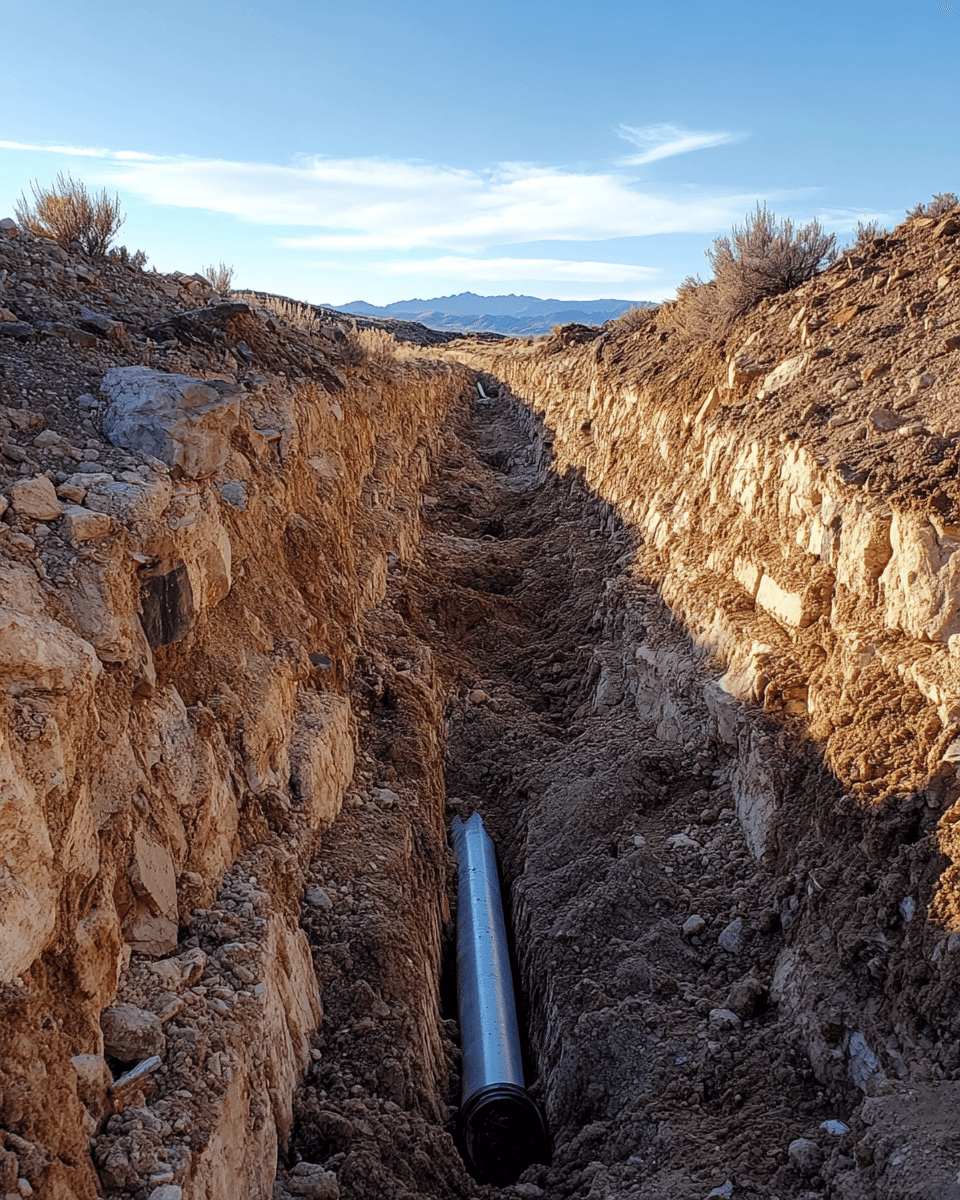
A luxury estate is only as functional as the infrastructure buried beneath it. Water, sewer, gas, power, data, and fire suppression all need to reach the structure on grade and on alignment — and when the home sits at the end of a twelve-hundred-foot driveway on a mountainside, that is a construction project in its own right.
On multi-structure estates with guest houses, pool buildings, and detached garages, the utility map becomes a network. Routing accounts for finish-grade elevations that change across hundreds of feet of terrain, frost-line depth that varies with exposure, and landscaping plans that cannot tolerate a cleanout in the middle of a motor court.
BY THE NUMBERS
Inch Frost Depth Compliance
WHAT'S INCLUDED
Scope of work
01
Water Service Trenching
Main-to-meter water line excavation buried below frost depth per Mountain Regional specs.
02
Sanitary Sewer Installation
Gravity-grade sewer laterals with engineered bedding and backfill for long-term settlement prevention.
03
Natural Gas Trenching
Gas line corridors excavated and backfilled to Dominion Energy specifications.
04
Electrical & Low-Voltage Conduit
Conduit trenching for primary power, data, and communication runs to every structure.
05
Fire Suppression Lines
Dedicated fire line trenching for large estates requiring independent suppression systems.
06
Granular Bedding Material
Specified bedding material supplied and placed to cushion pipe against rocky subsurface.
07
Compaction in Engineered Lifts
Backfill placed and compacted in controlled lifts with nuclear densometer testing.
08
Trench Plugs & Groundwater Management
Plugs installed to prevent trench lines from becoming groundwater conduits on steep lots.
09
Blue Stakes Coordination
Utility locate call-ins and field verification before any excavation begins.
10
Inspection & Documentation
Utility-provider inspections scheduled and compaction test records maintained for final acceptance.
OUR PROCESS
How a project moves
Every job — from first walk to final grade — moves through six deliberate stages.
Field Survey & Locate Call-Ins
Verify horizontal and vertical alignment against civil drawings. Call in Blue Stakes locates.
Trench Corridor Staking
Stake the trench corridor, confirm depths with utility engineer, identify conflicts with existing infrastructure.
Excavation to Spec Depth
Excavate with equipment sized for the corridor — mini excavators in tight areas, full-size on long runs.
Pipe/Conduit Set & Bedding
Install bedding material to specified depth and grade, set pipe or conduit per engineered specification.
Compaction in Lifts & Testing
Mechanically compact each lift with nuclear densometer verification before placing the next.
Utility Inspection & GC Turnover
Completed trench documented, inspected by utility provider, and turned over to the general contractor.
Field Survey & Locate Call-Ins
Verify horizontal and vertical alignment against civil drawings. Call in Blue Stakes locates.
Trench Corridor Staking
Stake the trench corridor, confirm depths with utility engineer, identify conflicts with existing infrastructure.
Excavation to Spec Depth
Excavate with equipment sized for the corridor — mini excavators in tight areas, full-size on long runs.
Pipe/Conduit Set & Bedding
Install bedding material to specified depth and grade, set pipe or conduit per engineered specification.
Compaction in Lifts & Testing
Mechanically compact each lift with nuclear densometer verification before placing the next.
Utility Inspection & GC Turnover
Completed trench documented, inspected by utility provider, and turned over to the general contractor.
CONDITIONS & EXPERTISE
Where we thrive
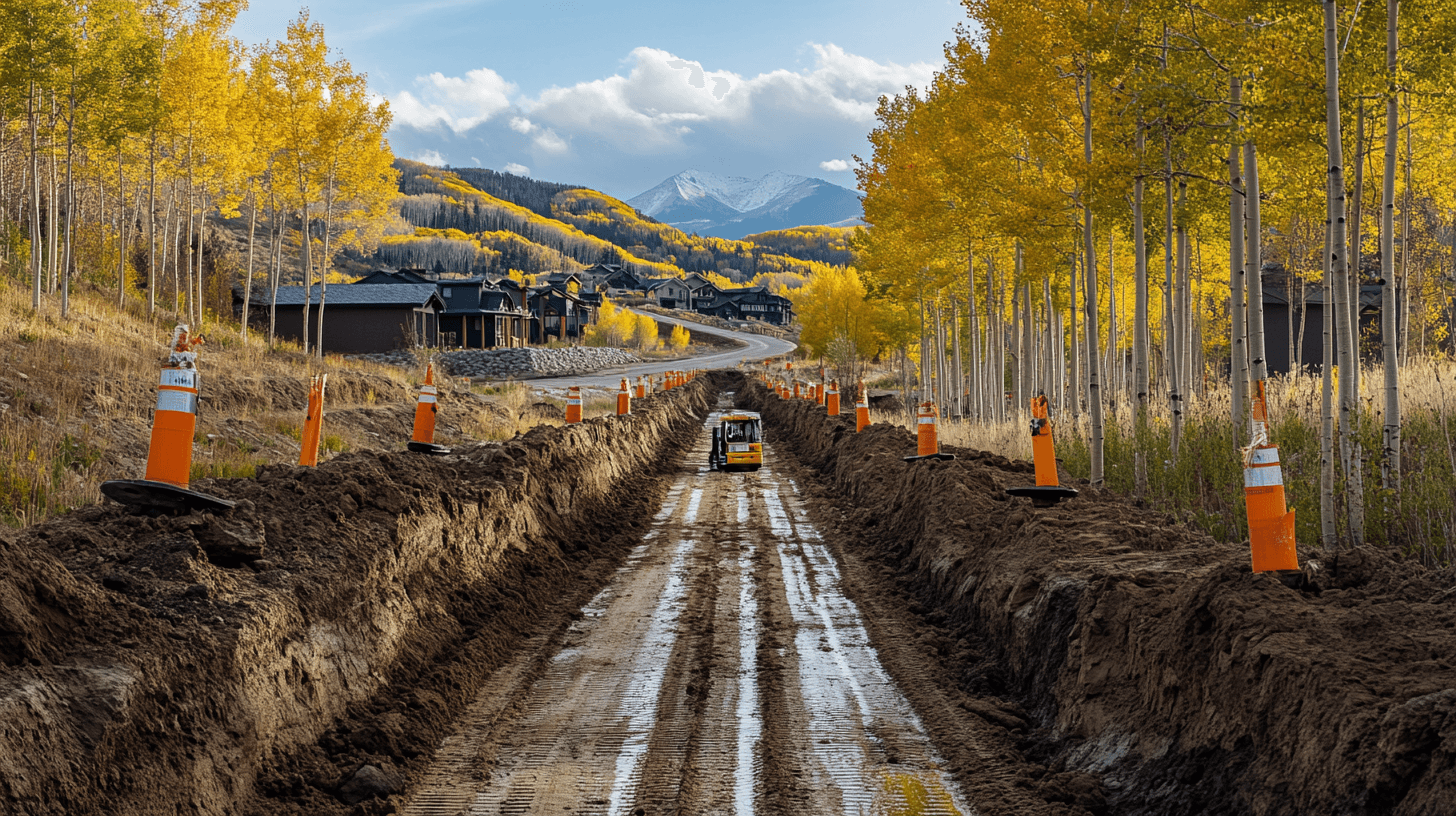
Frost depth in the Heber Valley runs 42–48 inches, meaning every water and fire line starts deeper than most Front Range contractors are used to digging. We coordinate directly with Mountain Regional Water, Heber Light & Power, Dominion Energy, and local sewer districts — each with its own inspection cadence, cover requirements, and backfill specs. That familiarity eliminates the back-and-forth that stalls utility phases on projects run by out-of-area contractors.
Utility Providers Coordinated
Max Frost Depth in Corridor
Inspection Pass Rate
FEATURED PROJECT
A recent build
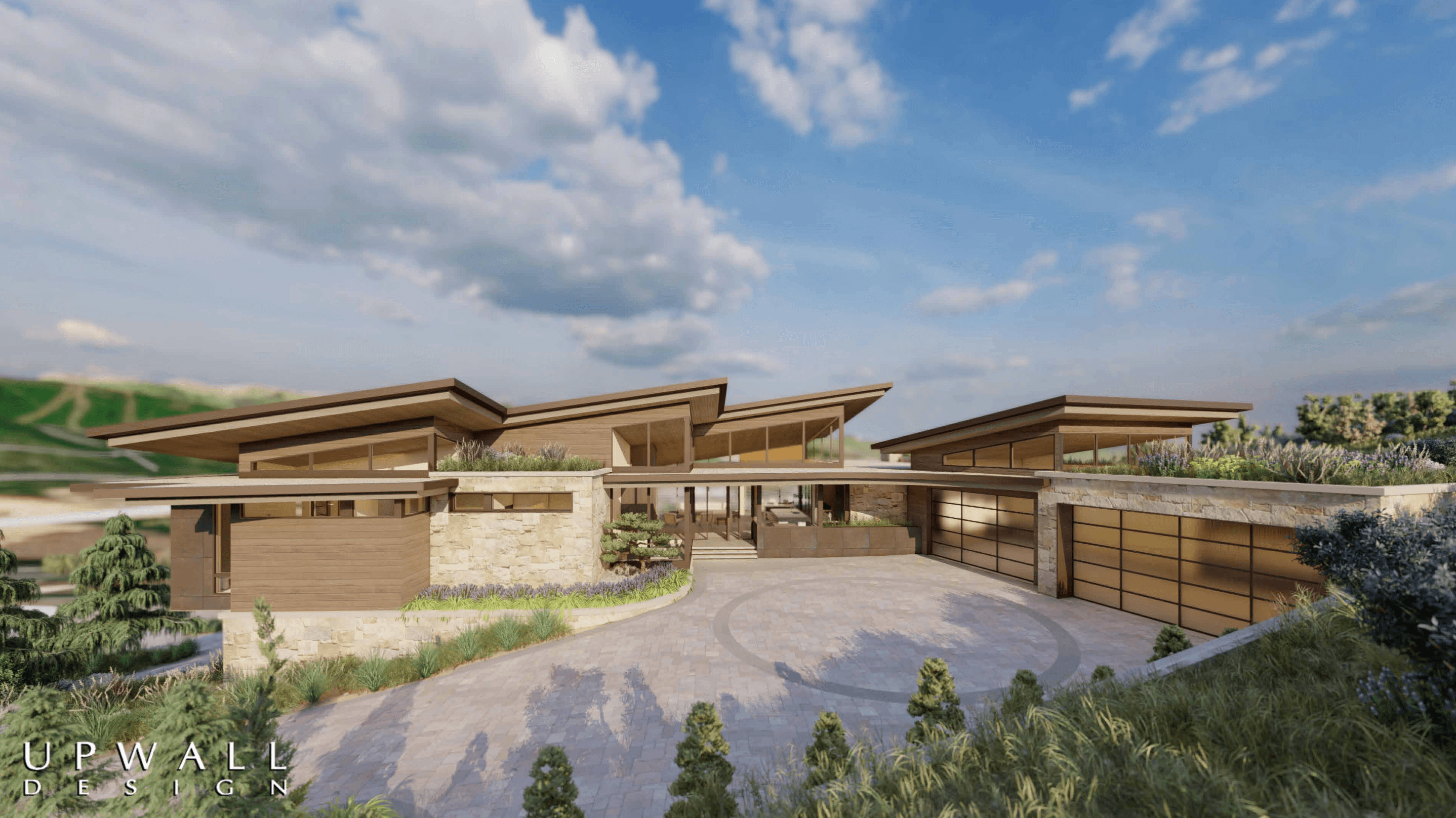
Park City, UT
Solamere — Lot 301
Site prep for a 17,000 square-foot Park City mansion at upper elevations. Mass excavation, engineered slope retention, utility trenching, and fine grading for architectural integration with natural terrain. Rock export and driveway access completed despite late-winter conditions.
FREQUENT QUESTIONS
Good questions deserve straight answers.
How deep do utility trenches need to be in the Heber Valley?
Frost depth in the Heber Valley and Park City area is forty-two to forty-eight inches, so water and fire lines must be buried below that threshold with additional cover specified by the serving utility. Sewer lines are depth-driven by grade requirements for gravity flow. Gas and electrical have their own cover minimums. We verify all depth requirements with the specific utility providers before trenching begins.
Can you trench through rock for utility installation?
Yes. Rocky subsurface is common throughout the Wasatch Back, and our fleet includes hydraulic breakers and rock-saw attachments designed for trench-width cuts. When solid rock is encountered, we break to grade, remove spoils, and install pipe bedding to cushion the utility line against the irregular rock surface. This is routine work for our crews.
Do you handle the utility company inspections?
We manage the full inspection cycle. We schedule the inspection windows with Mountain Regional Water, Heber Light & Power, Dominion Energy, and local sewer districts, then ensure the trench is ready and accessible when the inspector arrives. We also maintain compaction-test documentation and as-built records that the utility providers and the municipality require for final acceptance.
Can you install utilities for multi-structure estate properties?
Multi-structure estates are a significant portion of our utility work. Properties with guest houses, caretaker residences, pool buildings, and detached garages require branching utility networks with independent shutoffs and metering. We work from the civil engineer's utility plan to trench, install, and test every run, coordinating the sequence so that landscape grading and hardscape work can follow without recutting finished surfaces.
LET'S BUILD
Break ground with confidence.
Request a bid, walk the site with our team, or ask us what we'd do with your plans.
Or call us at (435) 671-0272